What to measure
How to use the stair stringer calculator
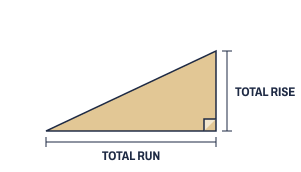
Measure the total rise from where the bottom step will land to the top of the deck or floor. Keep the riser and tread limits at the IRC values unless your local code differs. Enter the thickness of the treads you’ll put on, the stair width and the stringer board depth (11¼ in for a 2 × 12).
The results give the notch size for your framing square, how much to cut off the bottom, the stringer length and how many boards to buy.
The formula
- Risers = total rise ÷ maximum riser, rounded up; riser height = total rise ÷ risers
- Treads = risers − 1; total run = treads × tread depth
- Stringer length = risers × √(riser² + tread²)
- Wood left under the notches = board depth − riser × tread ÷ √(riser² + tread²)
- Bottom riser = riser height − tread thickness
- Stringers = 3, or width ÷ 18 in + 1 for stairs wider than 36 in
Worked example: 42 in rise, 36 in wide stair, 1 in treads
- 42 ÷ 7.75 = 5.4 → 6 risers of 7 in, 5 treads of 10 in, 4 ft 2 in of run
- Framing square: 7 in on the tongue, 10 in on the blade
- √(7² + 10²) = 12.21 in per step × 6 = 6 ft 1¼ in → 8 ft boards
- Under each notch: 11.25 − 70 ÷ 12.21 = 5½ in of wood
- Bottom riser: 7 − 1 = 6 in; 3 stringers
Stringers by total rise
| Total rise | Steps | Stringer length | Board |
|---|---|---|---|
| 18 in | 3 risers of 6 in | 2 ft 11 in | 4 ft |
| 24 in | 4 risers of 6 in | 3 ft 10⅝ in | 4 ft |
| 30 in | 4 risers of 7½ in | 4 ft 2 in | 6 ft |
| 36 in | 5 risers of 7³⁄₁₆ in | 5 ft 1⅝ in | 6 ft |
| 42 in | 6 risers of 7 in | 6 ft 1¼ in | 8 ft |
| 48 in | 7 risers of 6⅞ in | 7 ft ⅞ in | 8 ft |
| 60 in | 8 risers of 7½ in | 8 ft 4 in | 10 ft |
| 72 in | 10 risers of 7³⁄₁₆ in | 10 ft 3¼ in | 12 ft |
| 96 in | 13 risers of 7⅜ in | 13 ft 5⅝ in | 14 ft |
| 108 in | 14 risers of 7¹¹⁄₁₆ in | 14 ft 8¹³⁄₁₆ in | 16 ft |
10 in treads, 7¾ in maximum riser.
Common mistakes
- Forgetting to drop the stringer. Without cutting a tread’s thickness off the bottom, the first step is taller than the rest and the top step shorter. Uneven steps are a trip hazard.
- Measuring the rise from the wrong spot. Measure from where the bottom of the stair will actually land, level with the top. Sloping ground changes the rise across the stair.
- Overcutting the notches. Saw cuts that run past the corner weaken the stringer. Stop at the line and finish with a handsaw or jigsaw.
- Using a 2 × 10. It leaves too little wood under a full-size notch. DCA 6 calls for 2 × 12 stringers.
Frequently asked questions
How do I calculate stair stringers?
Divide the total rise by the maximum riser height and round up to get the number of risers; divide the rise by that number for the exact riser height. There is one fewer tread than risers. Each notch is one riser by one tread, set on a framing square.
How long should a stair stringer be?
About the number of risers times the diagonal of one step, √(riser² + tread²). For 6 risers of 7 inches with 10 inch treads that's 6 × 12.2 = 6 ft 1¼ in, so an 8 ft board.
How many stringers do I need?
AWC's deck guide (DCA 6) calls for at least three when only cut stringers are used. Stairs wider than 36 inches need stringers no more than 18 inches apart, so a 48 inch stair takes four.
What size lumber for stair stringers?
DCA 6 requires 2 × 12 stringers at minimum. A 2 × 12 is 11¼ inches deep, which leaves about 5½ inches of wood under a 7 × 10 inch notch.
Why is the bottom riser shorter?
The tread on top of each notch adds its thickness to every step except the first one, which sits on the ground. Cutting the thickness of one tread off the bottom of the stringer keeps every step the same height.
How do I mark a stringer with a framing square?
Clamp stair gauges or a straight board on the square at the riser height on the tongue (short arm) and the tread depth on the blade (long arm). Slide it along the board and trace each notch.
When does a stair need a landing?
DCA 6 requires an intermediate landing, built as a freestanding deck, when the total rise is more than 12 feet. Long stringers may also need a post partway up to shorten their span.
What riser height and tread depth are allowed?
The IRC allows risers up to 7¾ inches and treads at least 10 inches deep. The stair calculator explains the comfort rule and checks both limits.
Sources
Formulas and defaults last reviewed October 30, 2026. How we check our math.